
Your event · Decisions to prepare
Prepare your multi-site conference coordination.
A multi-site conference, including a hybrid conference format where needed, requires a common framework and distinct needs for each group. Specify journeys, venues and services to coordinate before requesting a clearly scoped quote.
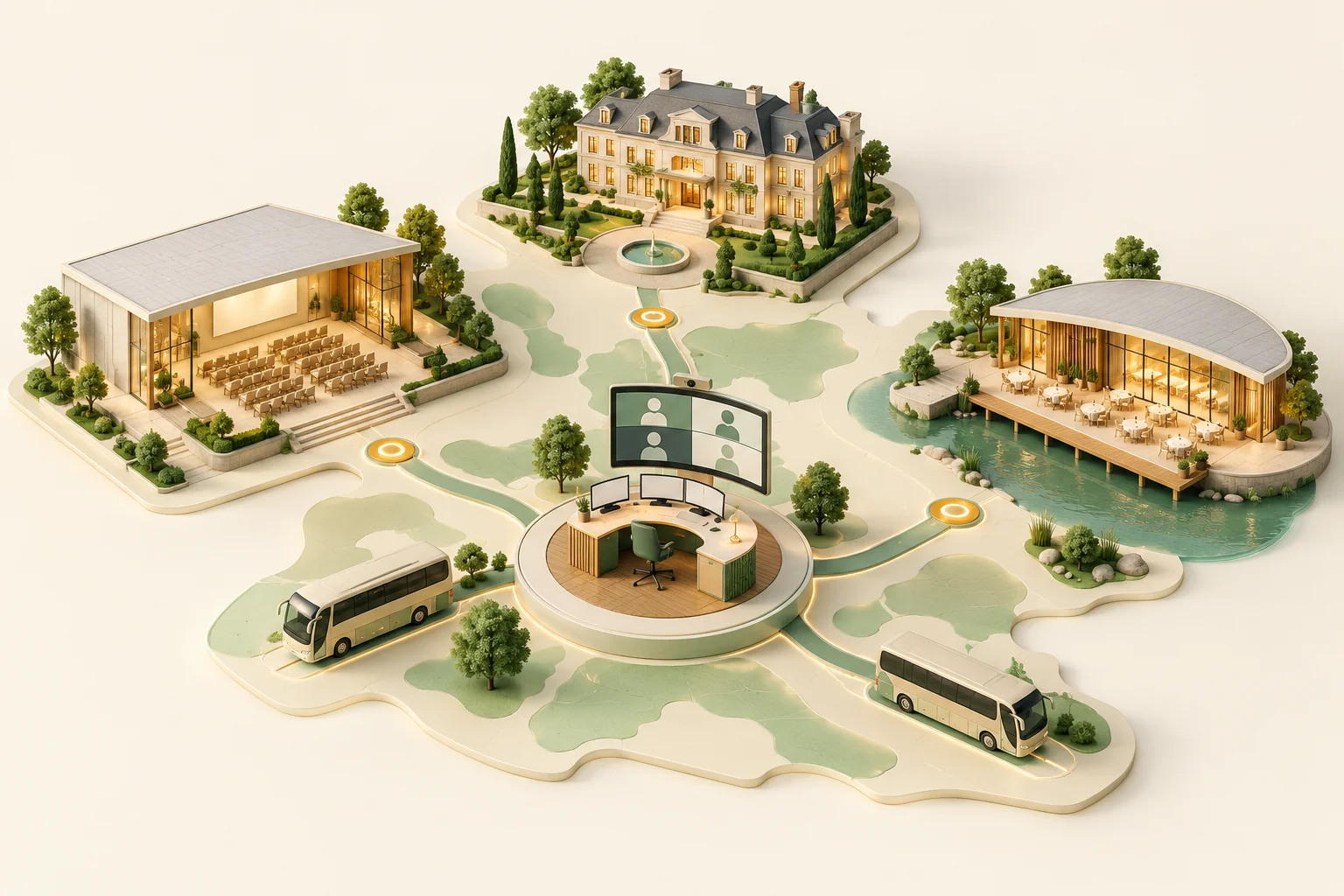
Clarify how each site participates.
A multi-site conference can bring teams from several locations to one venue or connect several venues during shared sessions. Describe the chosen format, sites and shared moments before sourcing services.
Identify headcount by site, speakers and time constraints. If teams span time zones, check local times for each session. One invitation does not guarantee that everyone can follow the programme under the same conditions.
- Distinguish departure sites from participation venues.
- Specify shared and local sessions.
- Have each site approve headcounts and times.
Prepare journeys and nights for each group.
List useful departure points, arrivals, returns and transfers between station, venue and accommodation. Prepare nights separately from programme days; groups may follow different journeys.
ADEME includes venue and transport choices in responsible event design. Compare practical options with programme constraints without claiming an impact reduction that has not been measured.
Reference: ADEME · Responsible events.
- Confirm arrival and departure periods.
- Distinguish nights, transfers and main journeys.
- Check practical access needs for each group.
Check what shared sessions depend on.
For a conference across several venues, specify presentations, broadcasting, remote exchanges and the coordinator at each site. Have sound, video, connectivity and support checked in the required configuration.
Prepare a test with relevant contacts and a fallback to confirm. For a shared venue, check simultaneous rooms, circulation and transitions instead. The arrangement depends on use; it cannot be inferred from a simple mention of an equipped room.
- Assign an operational contact to each venue.
- Prepare a running order and reference version.
- Confirm tests and the fallback arrangement.
Keep a common view and separate service statuses.
Prepare a common overview of services, owners and open points: venues, technical services, transport, accommodation and catering. Keep selected suppliers and specify only additions to source or coordinate.
BME acts as the single supplier within the Sourcing Force arrangement, while services retain separate statuses. Confirming one venue does not confirm services at other sites. The public brief prepares the request; it creates neither a purchase requisition nor an order.
- Identify the site, service and approval owner.
- Keep existing quotes and their inclusions.
- Record dependencies between shared and local services.
Prepare a useful summary for your brief.
Fictional example: two teams travel to a shared venue while a third joins the plenary remotely. The brief separates journeys and nights for the first two groups, then technical needs and the remote group contact. Each service keeps information to confirm.
CNIL highlights purpose limitation and data minimisation. Start with aggregated headcounts and practical needs, without named lists, medical details or internal files in the AI field. State the format, constraints and services to entrust when requesting a quote.
Reference: CNIL · Six GDPR principles.
- Describe the format and journeys of each group.
- Name site contacts and decisions to prepare.
- Share only useful information with authorised contacts.
| Point to prepare | Useful information | Decision to record |
|---|---|---|
| Format | Departure sites and participating venues | Shared and local sessions |
| Headcount | Expected numbers by group | Contact and confirmation date |
| Journeys | Travel, transfers and nights | Times and requirements to check |
| Technical services | Broadcasting, exchanges and support | Tests and fallback |
| Services | Requirements and existing choices | Status and approval owner |
| Coordination | Running order and open points | Shared version and next action |
Sources
- ADEME · Responsible events — accessed October 7, 2026.
- CNIL · Six GDPR principles — accessed October 7, 2026.